
Where Pressure Meets Proof
The Grid Asked a Question
The grid is under pressure. Everyone in our industry already knows that.
Demand is rising faster than planning cycles can absorb. Data centers are arriving in gigawatts, not megawatts. Interconnection rules are being rewritten while projects sit in the queue. And the old assumption that the grid will simply hold is no longer an assumption anyone can afford.
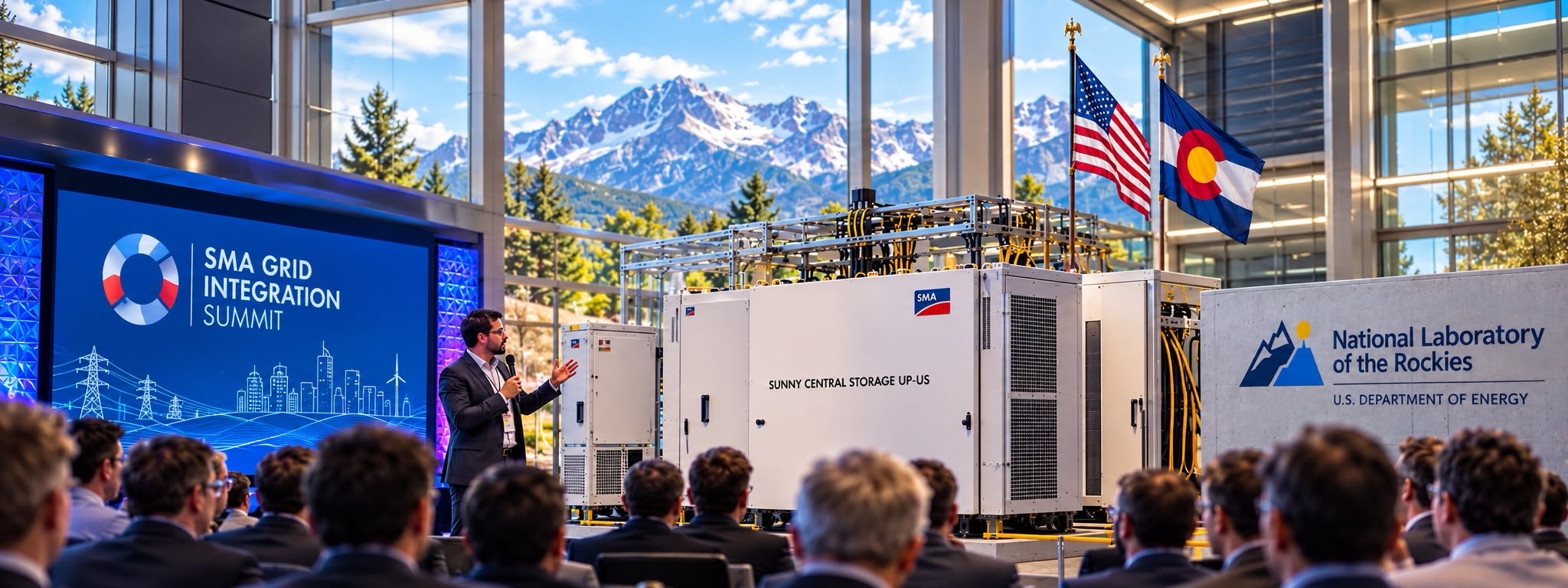
So when customers, developers, utilities, regulators and SMA colleagues gathered in Broomfield, Colorado for the second annual SMA Grid Integration Summit, the question in the room was not whether the grid needs help. The question was what kind of help, how fast, and who can prove it works.
Three days later, the answer felt clearer. Pressure is real. So is proof.
Day One: Naming the Pressure
SMA America’s Senior Director of Business Development, Frank Berring opened the summit with a simple message on the screen behind him. The grid is under pressure. Let’s talk solutions.
Ben Kroposki of the National Laboratory of the Rockies set the technical foundation. His session on grid-forming inverters and IEEE 2800.2 explained what the standard means for projects in development today, and what comes next. Grid forming is no longer a research topic. It is becoming a requirement.
Allan Alves Montanari, SMA America’s Director of Grid Integration brought that requirement down to earth with the Texas Waves II retrofit. Operating assets do not get to start over. They have to be upgraded to meet expectations that did not exist when they were built.
Omer Tzoore, SMA America’s Director of Market Solutions, made the case for stability-enhanced hybrids, giving PV the dispatchability and stability services that system operators increasingly demand. Candida Winkler closed the technical program by showing how predictive analytics turns fleet data into uptime.
Between sessions, Frank led an interactive workshop on a grid under pressure. It was the right instinct. The best ideas of the day came from the room, not only from the stage.
Day Two: Following the Load
If Day One named the pressure, Day Two followed it to its source. The demand is here. The solutions are evolving.
Jay Arghestani, SMA America’s Managing Director of Sales, Technology and Marketing, welcomed the room, and the morning moved quickly into policy. Eric Quiring, SMA’s Head of Public Affairs and Tom Hassenboehler of CO2EFFICIENT held a fireside chat on managing load while securing stability. Policy is no longer background noise for our business. It sets the pace.
The engineering followed. Allan Montanari explained the role of EMT models in IBR regulatory compliance. Arman Ghasaei of EdgeTunePower showed how hardware-in-the-loop testing reduces commissioning and revenue risk. Parag Mitra of EPRI looked at fluctuating load through the lens of grid reliability.
The afternoon belonged to large loads. Tom Scaramellino of GridStrong, Todd Hillman of MISO and Erik Ela of ESIG mapped the emerging regulatory requirements. Steffen Aust presented SMA’s grid-ready solutions for data centers. Lucas Meubrink, SMA America’s Principal Applications Engineer, asked whether load ride through and IBR grid services can coexist. Tim Stocker, SMA America’s Data Center System Architect compared transformer rectifier units with solid state transformers for the next generation of data center power.
Frank closed with a look inside SMA’s test labs. It was the perfect bridge to what came next.
Day Three: Where Solutions Are Proven
On Friday we drove to Golden for a tour of the Energy Systems Integration Facility at the National Laboratory of the Rockies. The words on the atrium glass said it well. Welcome to the future of energy.
One of the first things we saw was a national map of data center infrastructure set against transmission lines and fuel networks. No slide could have made the point more clearly. The load is concentrating, and the grid has to meet it where it lands.
We walked past displays of the ARIES platform and the real-time super lab concept, which links research facilities across the national laboratory system. Then we stepped onto the lab floor.
There, inside national research infrastructure, stood SMA equipment. A Central Storage UP-S inverter. A Power Plant Manager powered by ennexOS. Seeing our technology integrated into that environment was a moment of real pride.
The team then presented a DOE-supported project with NLR and SMA focused on de-risking data center technologies. It answered, in practical terms, the question the summit had been circling for two days. How do you prove a solution before the grid depends on it?
Why It Matters Beyond Colorado
From the Southeast and the Caribbean, these conversations land close to home.
In Florida, resilience is not a talking point. It is hurricane season, rapid load growth and a utility landscape that expects performance. In Puerto Rico and the Dominican Republic, island grids feel every disturbance directly. Grid-forming capability and stability services are not future features there. They are what makes the next project bankable.
The summit also showed something about us. Speakers came from SMA America and SMA Solar Technology in Germany. Engineering, public affairs, market solutions, data centers and sales shared one stage. That is our real advantage. Customers do not buy a subsidiary. They buy confidence that the whole of SMA stands behind the solution.
The more we connect our regions, the stronger that confidence becomes. What we learn in Texas and Colorado should reach Florida, San Juan, Santo Domingo, Santiago and São Paulo just as quickly.
Gratitude, and a Question
Thank you to every customer, developer, utility and partner who joined us in Broomfield. Your questions made the discussions sharper and more grounded. Thank you to every speaker who brought real experience to the stage. Thank you to the National Laboratory of the Rockies for opening its doors. And thank you to the entire SMA team, across America and Germany, for three outstanding days.
The grid is under pressure. That will not change soon.
What can change is how quickly we move from conversation to proof, and from proof to projects in the field.
So here is the question I am taking home. If grid-forming technology is ready to be proven, which market will be first to make it the standard rather than the exception?
Feel free to contribute!