
Floating Solar: The Rising Potential of Floatovoltaics
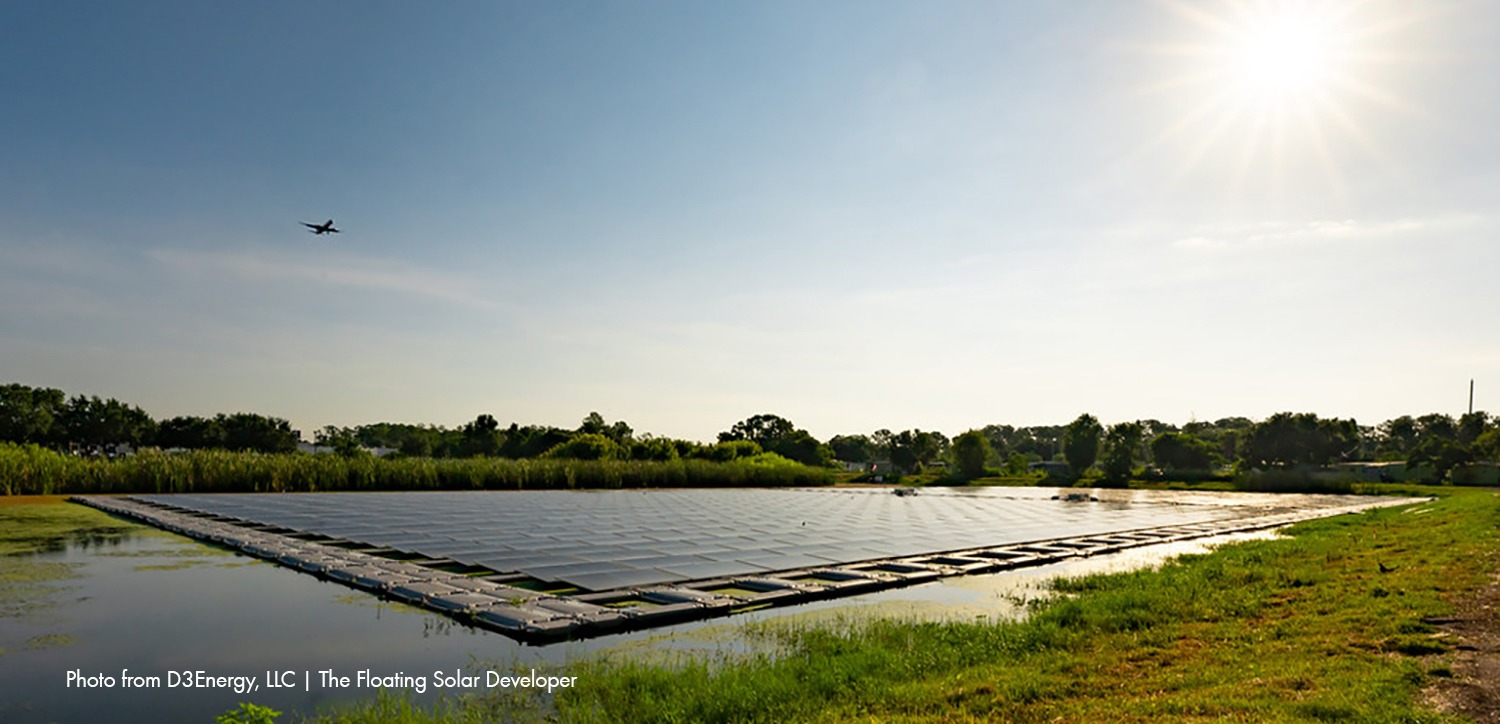
Floating solar, also known as floating photovoltaics (FPV) or “floatovoltaics” is rapidly emerging as one of the most promising innovations in renewable energy. As land availability becomes increasingly constrained, floating solar provides an efficient, scalable solution by utilizing water surfaces instead of terrestrial space. This innovative approach is reshaping how utilities, developers and municipalities expand solar generation while conserving precious land and water resources.
What Is Floating Solar?
Floating solar installations place photovoltaic modules on bodies of water such as reservoirs, lakes and retention ponds. Modules are mounted on interlocking buoyant platforms designed to rise and fall with changing water levels. These platforms are secured using mooring and anchoring systems, helping to ensure stability in various conditions.
The growth in floating solar is driven by:
- State and federal clean energy mandates
- Increasing land use constraints
- Opportunities to optimize underutilized bodies of water
- Water management challenges in drought prone regions like California and Florida
The result is a high value, dual-use solution that combines renewable energy production with water conservation.
Key Benefits of Floating Solar
Land Conservation and Environmental Protection
By building solar arrays on water instead of land, floating solar avoids land clearing, grading and ecosystem disruption. This preserves valuable farmland, natural habitats and open space, making it especially advantageous in densely populated or land-restricted areas.
Higher Energy Efficiency
According to research studies from the Netherlands Organisation for Applied Scientific Research (TNO) and the Solar Energy Research Institute of Singapore (SERIS) show that floating solar systems outperformed ground-mounted and rooftop PV installations. Water naturally cools the modules, helping them operate more efficiently. By floating on reservoirs or lakes, the modules experience less heat stress than land-based systems. This improved thermal regulation, boosting overall performance and energy yield. As a result, floating solar frequently delivers higher output than comparable ground-mounted systems in research studies.
Reduced Water Evaporation
Floating arrays shade the water beneath them, significantly reducing evaporation. This is an important benefit for water-stressed regions. In certain reservoirs, this can help support water supply stability and reduce environmental strain.
Lower Soiling and Maintenance
Because floating solar systems are situated on water, they accumulate less dust and debris than land-based solar arrays. This reduces cleaning frequency and supports higher long-term system output.
Ideal for Colocation with Hydropower
Floating solar can be paired with existing hydropower facilities, sharing transmission lines, infrastructure and maintenance resources, making it a cost-effective expansion strategy.
According to the National Renewable Energy Laboratory (NREL), U.S. reservoirs alone have the potential to support 861 to 1,042 GW of floating solar capacity. This is enough to generate nearly half of the solar energy required to decarbonize the national grid by 2050.
Community Impact of Floating Solar
Stakeholders often ask how floating solar impacts aquatic ecosystems. Research and real-world deployments indicate that floating solar can positively contribute to water and habitat health by:
- Providing shade that limits harmful algal blooms
- Reducing surface temperatures
- Minimizing land disturbance
- Helping stabilize water levels through reduced evaporation
Compared with ground-mount solar, floating systems require significantly less site preparation, avoiding land grading, trenching or vegetation clearing, further reducing environmental impact.
Florida continues to lead in floating solar innovation, most notably through the Orlando Utilities Commission’s (OUC) landmark floating solar project. In partnership with D3Energy, the nation’s leading floating solar developer with the most systems deployed in the United States, OUC built the state’s largest floating solar array on a Department of Transportation retention pond.
Project highlights include:
- Project Capacity: 2.0 MW
- Panels: ZNShine 660W
- Floating Racking: Hydrelio® system by Ciel & Terre
- Inverters: Thirteen SMA 125 kW Highpower PEAK3
The installation demonstrates how floating solar can unlock new clean energy capacity in regions where available land is limited or costly. Its success also positions Orlando as a model for utilities nationwide seeking space efficient solar expansion.
Countries such as Singapore, Japan, China, the Netherlands and India are actively scaling floating solar, with some projects planned to exceed an average of 100 MW. These global deployments show that floating solar is not only technically viable but also economically competitive, especially as platform materials, anchoring systems and installation practices continue to advance.
As climate resilience, water conservation and energy diversification become top priorities, floating solar provides a unique pathway to meet sustainability goals without compromising land resources. Continued innovation in floating platforms, hybrid hydropower integration and large-scale reservoir applications will push this niche sector forward in the coming decade.
Floating solar represents a smart, efficient and scalable evolution in renewable energy development. The Orlando Utilities Commission project demonstrates what’s possible when water surfaces are transformed into productive, low impact clean energy assets. For stakeholders exploring sustainable, space conscious energy solutions, floating solar offers a compelling opportunity to lead the next wave of solar innovation energy development.
If your community or organization is seeking ways to expand solar capacity while maximizing land and water resources, now is the time to explore local floating solar opportunities.
Feel free to contribute!